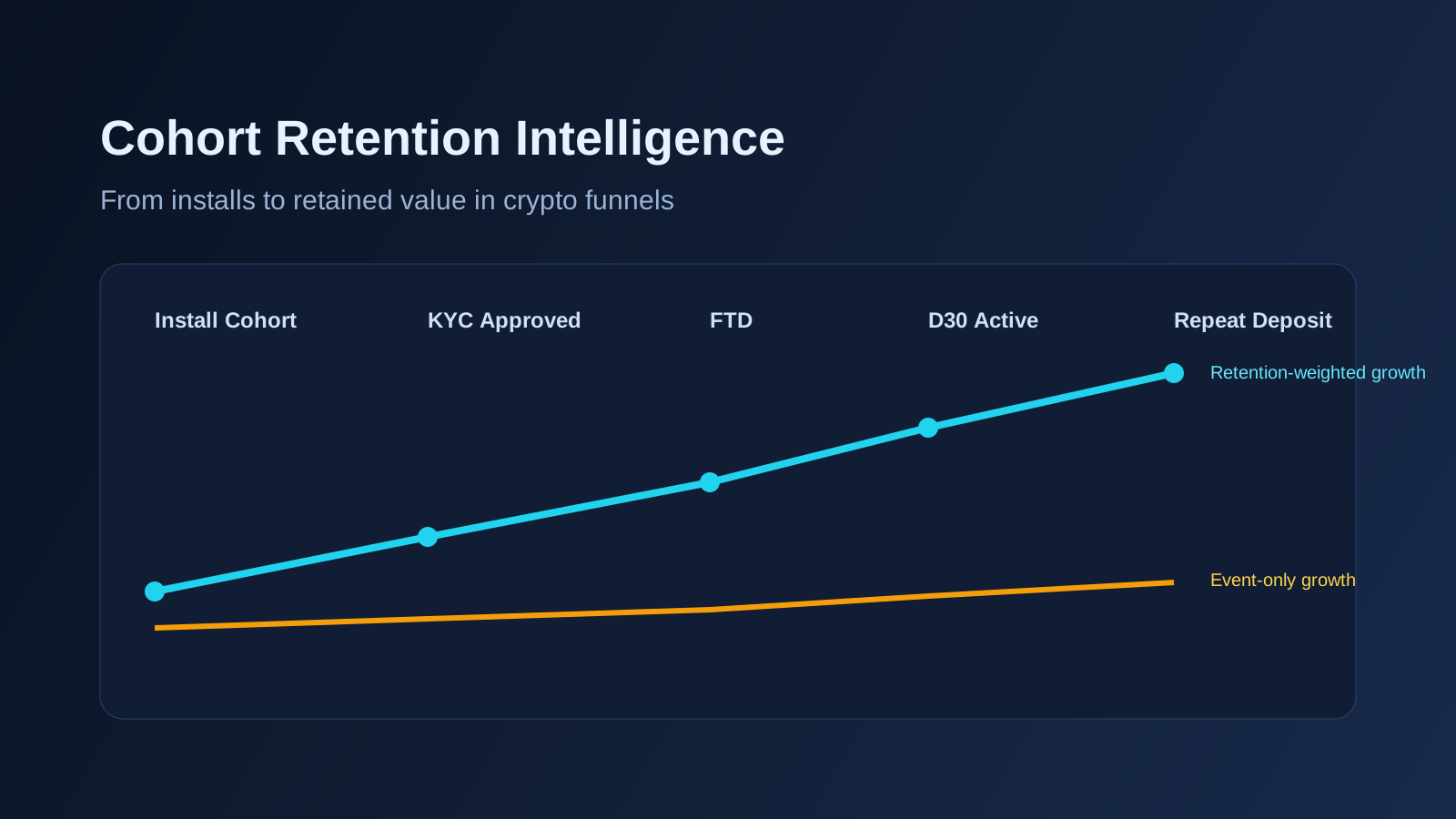
Cohort Retention Intelligence for Crypto Funnels: The Complete Operator's Guide
A deep practical guide for crypto growth teams to optimize retained cohort value using full-funnel metrics, retention-weighted allocation, and weekly operating governance.
Get Your Free Crypto Funnel Audit
Upload your CSV and instantly see where users drop off from install to first deposit — free.
Cohort Retention Intelligence for Crypto Funnels: The Complete Operator’s Guide
Most crypto growth teams know how to buy installs.
Fewer know how to buy retained value.
That difference is where profitability is made or destroyed.
If your team tracks CPI, CTR, and short-window ROAS but still struggles with stable growth, the issue is usually not top-of-funnel volume. It is cohort quality decay hidden in the middle and bottom of your funnel.
This guide explains how to build a cohort retention intelligence system specifically for crypto funnels so you can move from campaign-level guesswork to compounding, repeatable growth.
Why Cohort Intelligence Matters More in Crypto Than in Generic SaaS
In many traditional SaaS models, user behavior is relatively stable. In crypto, behavior volatility is structurally higher because it is influenced by:
- Market sentiment cycles.
- Asset volatility.
- Regulatory headlines.
- Deposit/withdrawal confidence.
- Regional payment and compliance friction.
That means two users acquired at the same cost can produce very different value trajectories depending on:
- Acquisition source.
- Country.
- Device and onboarding context.
- Time period (bull, neutral, risk-off).
Without cohort intelligence, these differences collapse into averages that look “fine” until margin erodes.
The Core Problem: You Are Optimizing Events, Not Behavior Curves
Most dashboards answer:
- How many installs did we get?
- What was our CPI?
- How many first deposits happened?
Cohort intelligence answers a deeper set:
- Which acquisition cohorts sustain activity after day 7 and day 30?
- Which cohorts produce repeat deposits vs one-time spikes?
- Which channels produce stable LTV, not just early conversion?
- Which countries are improving retention quality over time?
Events are points.
Retention is a curve.
Profitable growth depends on curves.
Cohort Definitions You Should Standardize
Before analysis, align your team on cohort definitions.
Acquisition Cohort
Users grouped by install week (or day) and source attributes:
- Channel
- Campaign
- Country
- Platform
Activation Cohort
Users grouped by first meaningful milestone, usually:
- KYC approved date, or
- FTD date
Value Cohort
Users grouped by early value intensity, such as:
- First deposit amount bands
- First-week activity frequency
Using all three cohorts gives better causal clarity than relying on install cohorts only.
The Crypto Funnel Cohort Model
For each cohort, track progression across:
- Install
- Registration
- KYC started
- KYC approved
- FTD
- FTT
- D7 active
- D30 active
- Repeat depositor status
Then calculate cohort-specific rates between stages.
This creates a behavioral fingerprint per cohort rather than a single conversion number.
Retention Metrics That Actually Drive Decisions
D1, D7, D30 Active Rate
Basic but essential. Track by cohort segment, not globally.
Deposit Recurrence Rate
Percentage of users who make a second deposit within 30 days.
This is often a better quality signal than first deposit count alone.
Time-to-Second-Action
How long from FTD to next meaningful action (second deposit or first trade).
Long delay usually predicts weaker long-term retention.
Revenue Density per Active User
Cumulative net revenue divided by active users in cohort window.
Useful for comparing cohorts with similar retention but different monetization quality.
Retention-Adjusted CAC
Acquisition cost divided by retained active users (e.g., D30 retained users), not just installs or registrations.
This metric quickly exposes channels that look cheap at top funnel but expensive at durable value stage.
The 8-Step Cohort Retention Workflow
Step 1: Freeze Time Windows
Use a fixed analysis cadence:
- Weekly operational view (recent movement)
- 30-day tactical view (execution decisions)
- 90-day strategic view (trend and seasonality)
Mixing windows leads to false confidence.
Step 2: Build Segment Grids
At minimum, build cohort grids by:
- Channel x week
- Country x week
- Platform x week
Then overlay KYC and deposit behavior.
Step 3: Identify Retention Breakpoints
Find stage where future retained value diverges across cohorts.
Common breakpoints in crypto:
- KYC submission friction
- Approval latency
- FTD-to-FTT transition
Step 4: Separate Intent vs Friction Effects
If one cohort has high start intent but low continuation, likely UX or trust friction.
If start intent itself is weak, likely acquisition mismatch.
Step 5: Prioritize by Recoverable Value
Not every weak cohort deserves equal effort. Rank by:
- Cohort size
- Expected retained value lift
- Ease/time of intervention
Step 6: Run Cohort-Specific Experiments
Examples:
- Country-localized KYC guidance
- Post-approval deposit onboarding sequences
- Channel-specific landing-message alignment
- Payment method prioritization by region
Step 7: Reallocate Budget with Retention Weights
Budget should follow retention-adjusted economics, not short-window ROAS only.
Step 8: Institutionalize Weekly Review Rhythm
Create a fixed retention review with owners from growth, product, analytics, and ops.
What Crypto Funnel Analyzer Gives You in This Workflow
Cohort retention intelligence requires connected data across funnel stages.
Crypto Funnel Analyzer is valuable because it combines:
- End-to-end funnel stage visibility.
- Channel comparison with conversion and economics context.
- Country-level anomaly spotting.
- Alerting for performance degradation.
- Whale and high-value behavior visibility.
Instead of fragmented exports, your team can analyze cohort quality in one operating surface.
Cohort Segmentation Patterns That Usually Reveal Hidden Value
Pattern 1: “Cheap Install, Expensive Retention” Channel
Symptoms:
- Low CPI
- Decent registration
- Weak D30 retention
Action:
- Downweight budget despite top-funnel efficiency
- Improve pre-qualifying creative intent
Pattern 2: “Moderate ROAS, Strong Durability” Cohort
Symptoms:
- Average day-7 metrics
- Strong D30 active and repeat deposit rates
Action:
- Increase budget gradually
- Protect from short-term optimization pressure
Pattern 3: Country-Specific KYC Latency Drag
Symptoms:
- Good KYC start rates
- Slow approval, weak downstream retention
Action:
- Improve verification flow for targeted countries
- Set approval SLA alerts
Pattern 4: Whale Spike Bias
Symptoms:
- One cohort has high revenue due to few large users
- Median user behavior remains weak
Action:
- Avoid overallocating budget based on outlier revenue
- Use distribution-aware scorecards
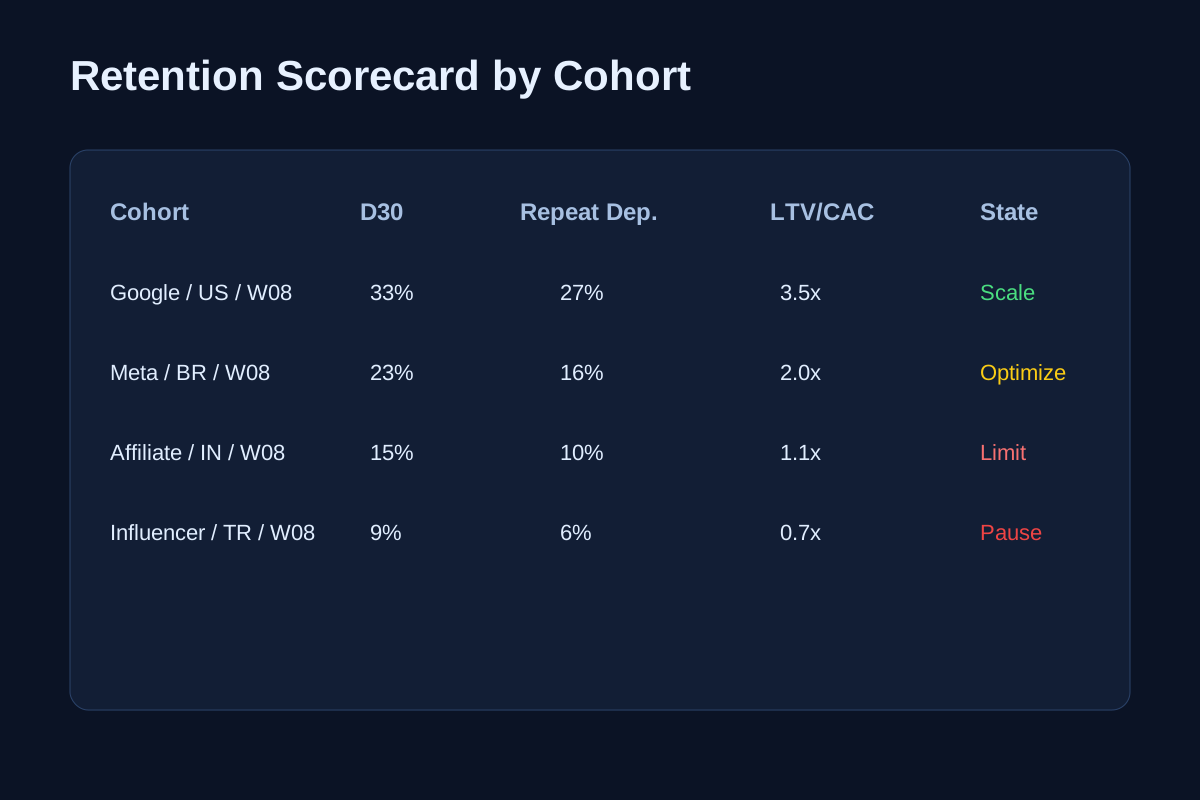
Build a Retention-Weighted Allocation Score
A practical scoring formula:
Retention Allocation Score =
- 25% D30 retention
- 20% Repeat deposit rate
- 20% LTV/CAC (30 or 60-day)
- 15% KYC approval quality
- 10% Cost per FTD
- 10% Volatility penalty inverse
Use this score per channel-country cohort.
Decision states:
- Scale
- Hold/Optimize
- Limit
- Pause
This creates predictable allocation governance.
Experiment Ideas That Improve Cohort Retention
- Post-KYC momentum sequence
Trigger clear “what next” and deposit CTA immediately after approval.
- First-week education flow
Contextual onboarding for first trade and risk controls to reduce confusion churn.
- Payment method routing by geo
Prioritize successful local rails to reduce deposit abandonment.
- Support escalation trigger
Detect repeated failures and surface real-time support.
- Channel-message consistency tests
Align ad promise with onboarding flow expectations.
- Inactivity rescue sequence
Trigger cohort-aware nudges after 48-72h inactivity.
Each experiment should map to one cohort KPI and one owner.
Common Retention Intelligence Mistakes
Mistake 1: Over-trusting global averages
Global averages hide profitable micro-segments and costly sinkholes.
Mistake 2: Treating all cohorts as comparable too early
New cohorts need maturation windows before final judgment.
Mistake 3: Optimizing only for first deposit
One-time conversion without recurrence rarely produces stable margin.
Mistake 4: Ignoring variance and confidence
Low-volume cohorts produce noisy signals. Build confidence-aware decision rules.
Mistake 5: No ownership model
Without clear owners, insights remain analysis artifacts, not actions.
Governance Blueprint: Weekly and Monthly
Weekly (30–45 minutes)
- Cohort scorecard movement by channel/country.
- Alert review (KYC, FTD, retention, CPI spikes).
- Budget decisions for next week.
- Experiment status and blockers.
Monthly (60–90 minutes)
- 90-day trend audit.
- Which cohorts graduated to “scale” state?
- Which assumptions failed?
- Strategic reallocation map for next month.
Consistency beats complexity.
Forecasting Cohort Lift Before You Spend More
Before scaling, model expected impact:
Inputs:
- Current cohort size and spend.
- Current D30 retention.
- Expected retention lift from intervention.
- Revenue per retained active user.
Outputs:
- Incremental retained users.
- Incremental revenue.
- Incremental payback impact.
This prevents reactive “spend first, diagnose later” behavior.
Leadership Dashboard: What Executives Should See
Executives should not receive raw event dashboards.
They need a concise retention intelligence board:
- Retention-adjusted CAC trend.
- D30 retained value by top cohorts.
- Budget share by channel state (scale/optimize/limit).
- Forecasted payback shift from recent reallocations.
- Top risks and owners.
This keeps strategic conversations tied to durable economics.

90-Day Implementation Plan
Phase 1 (Days 1–30): Foundation
- Standardize cohort definitions.
- Instrument missing funnel events.
- Build baseline scorecards.
- Set alert thresholds.
Phase 2 (Days 31–60): Optimization
- Run 3–5 cohort-targeted experiments.
- Introduce retention-weighted allocation rules.
- Launch weekly governance rhythm.
Phase 3 (Days 61–90): Scale
- Reallocate budget to proven cohorts.
- Retire low-durability segments.
- Formalize monthly strategic review.
By day 90, most teams see clearer budget confidence and less performance whiplash.
Practical KPI Targeting Framework
Set directional targets by maturity stage:
Early stage team:
- Improve D30 retention consistency before aggressive scaling.
- Reduce cohort volatility.
Growth stage team:
- Increase share of spend in top retention quartile cohorts.
- Improve repeat deposit contribution.
Scale stage team:
- Minimize retention-adjusted CAC drift.
- Improve forecast reliability across market cycles.
Targets should evolve with system maturity.
Final Takeaway
Cohort retention intelligence is not a reporting upgrade. It is a decision system.
When crypto teams shift from event counting to behavior-curve management, they stop confusing activity with value. They identify where durable revenue is created, where it leaks, and where budget should actually go.
The result is not just better analytics.
It is a stronger growth operating model: one that remains effective even when markets are volatile, competition is aggressive, and acquisition costs are unstable.
If you want consistent, profitable growth in crypto, build your funnel around retained cohort value, not top-of-funnel volume.
That is where compounding starts.
CryptoFunnel Team
Crypto Analytics Experts
We help crypto and Web3 companies optimize their user acquisition funnels — from install to first deposit. Our analytics platform is trusted by 500+ teams worldwide.
Verified Data
Real campaign metrics
500+ Teams
Trust our platform
Always Current
Regularly updated