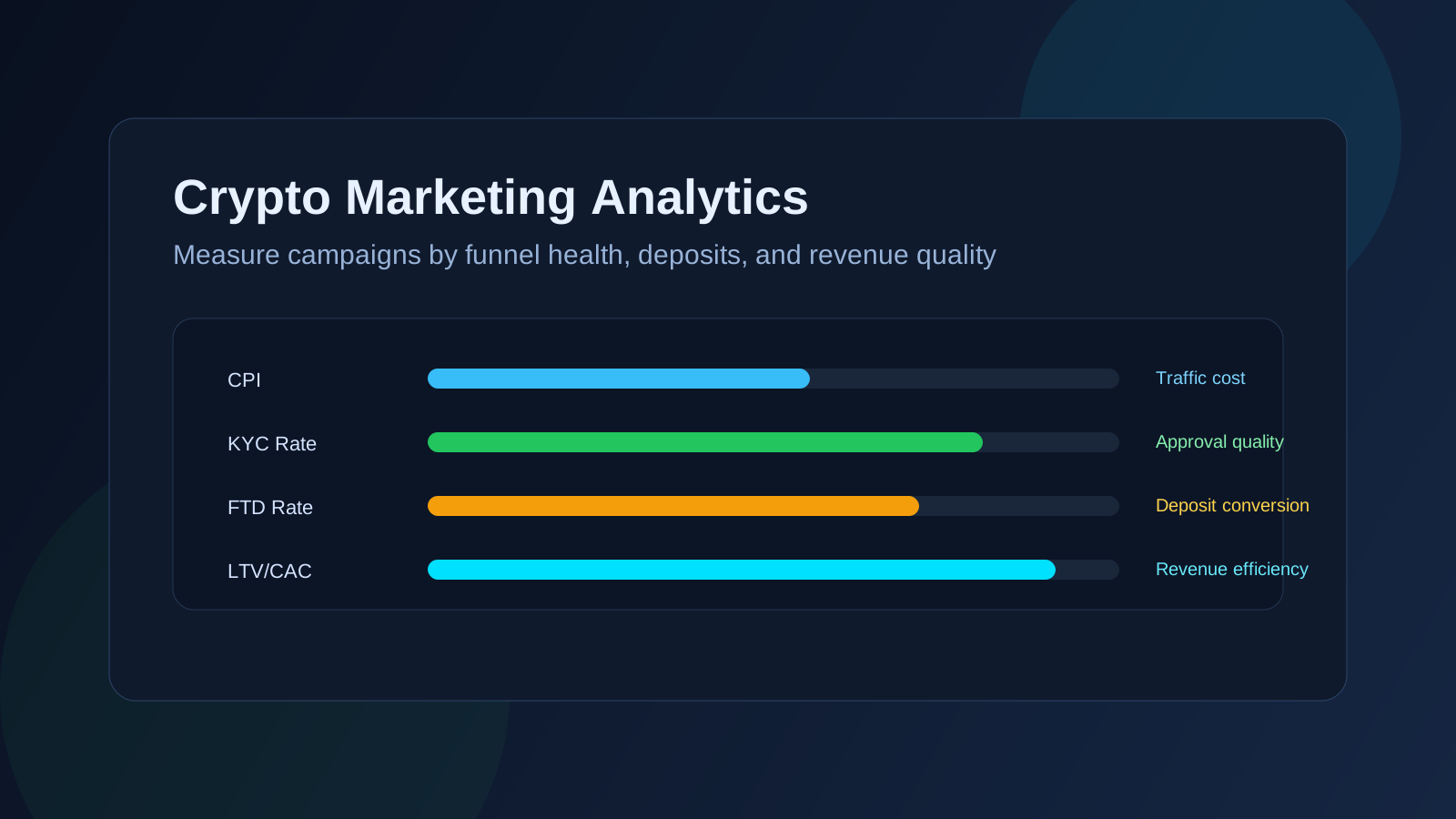
Crypto Marketing Analytics: The Complete Guide to Measuring Campaign Performance and Revenue Quality
Crypto marketing analytics is not the same as generic performance reporting.
Get Your Free Crypto Funnel Audit
Upload your CSV and instantly see where users drop off from install to first deposit — free.
Crypto Marketing Analytics: The Complete Guide to Measuring Campaign Performance and Revenue Quality
Crypto marketing analytics is not the same as generic performance reporting.
Most growth dashboards were built for e-commerce, lead generation, or mobile apps with relatively simple activation flows. Crypto businesses operate in a much more complex environment. Users may click an ad, install an app, register, complete KYC, make a first-time deposit, place a trade, and only then generate real revenue. If your reporting stops at clicks or installs, you are optimizing the wrong layer of the business.
This guide explains how crypto marketing analytics should work, which metrics matter most, and how growth teams can connect traffic acquisition to deposits, retention, and lifetime value.
What Is Crypto Marketing Analytics?
Crypto marketing analytics is the process of measuring how acquisition channels, campaigns, geographies, and user cohorts contribute to downstream business outcomes such as KYC approval, first-time deposits, trading activity, retention, and LTV.
In practical terms, it helps teams answer questions like:
- Which channels produce the strongest first-time deposit rate?
- Which campaigns drive cheap installs but weak revenue quality?
- Where is KYC drop-off hurting CAC efficiency?
- Which countries create the best retained cohorts?
- Which traffic sources produce whales or high-value users?
The goal is not to look at more dashboards. The goal is to make better budget and product decisions with a full-funnel view.
Why Generic Dashboards Fail Crypto Teams
Traditional ad dashboards are useful for media management, but they do not show the full commercial journey. They usually focus on:
- Impressions
- Clicks
- CTR
- CPI
- Cost per registration
Those are useful input metrics, not final business outcomes.
A crypto exchange or trading app usually makes money much later in the funnel. That means a campaign can look excellent in the ad platform while underperforming badly in actual revenue terms. You only discover that when you connect media data to activation and monetization metrics.
The Core Funnel for Crypto Marketing Analytics
A strong analytics model should measure the full user journey:
- Click or visit
- Install
- Registration
- KYC started
- KYC approved
- First-time deposit
- First trade or transaction
- Retention milestone
Every team should agree on these stage definitions. If growth, analytics, product, and compliance all use different stage logic, optimization becomes noisy and slow.
Metrics That Matter Most
Acquisition Efficiency Metrics
- Cost per click
- Cost per install
- Cost per registration
- Cost per KYC-approved user
- Cost per first-time deposit
Conversion Quality Metrics
- Install-to-registration rate
- Registration-to-KYC start rate
- KYC approval rate
- KYC-to-FTD rate
- FTD-to-first-trade rate
Revenue Metrics
- Average first deposit amount
- Average revenue per activated user
- Payback period
- ROAS
- LTV/CAC ratio
Cohort Quality Metrics
- D7 retention
- D30 retention
- Repeat deposit behavior
- Whale percentage
- Revenue concentration by channel or geo
Looking at these groups together gives a realistic picture of marketing performance.
The Most Important Segments to Track
Crypto marketing analytics becomes much more useful when data is segmented properly. The most valuable slices are:
- Channel
- Campaign
- Country
- Platform
- Cohort week
- Deposit tier
These segments help you find patterns that averages hide. For example, a channel may look average globally but perform exceptionally well in one country. Another campaign may have a higher CPI but much better KYC completion and first-time deposit quality.
Where Crypto Teams Usually Misread Performance
Mistake 1: Optimizing for cheap volume
Cheap installs are attractive, but low-intent traffic can damage the full funnel. If users do not complete KYC or never deposit, low CPI is meaningless.
Mistake 2: Ignoring KYC as a revenue stage
KYC is one of the biggest economic checkpoints in crypto. If KYC completion drops, downstream CAC rises immediately. That should be treated as a growth issue, not just a compliance issue.
Mistake 3: Looking at ROAS too early
Short-term ROAS often hides cohort quality differences. Some channels monetize later but retain much better. Others look strong at day 7 and collapse by day 30.
Mistake 4: Not segmenting by geography
Country-level effects are often stronger than channel-level effects in crypto. Payment rails, identity verification, user trust, and regulation all vary by market.
A Practical Analytics Workflow
The best teams use a repeatable weekly workflow:
- Review funnel conversion rates for the last 7 and 30 days.
- Compare channels on cost per KYC-approved user and cost per FTD.
- Flag the largest drop-off stage.
- Segment that stage by country, platform, and campaign.
- Check retention and deposit quality before reallocating budget.
- Launch one targeted fix or experiment.
- Monitor alerts for CPI, KYC, FTD, or whale anomalies.
This rhythm creates faster decisions and clearer ownership.
What Good Crypto Marketing Reporting Looks Like
A strong reporting setup usually includes:
- A full-funnel dashboard from install to retention
- Channel comparisons tied to cost and conversion quality
- Country-level breakdowns
- Cohort views for retention and LTV
- Alerting for sudden declines in KYC or FTD
- A clear weekly scorecard for growth and leadership
The point is not to measure everything. The point is to measure the right stages consistently.
How Crypto Funnel Analyzer Helps
Crypto Funnel Analyzer is built for exactly this kind of reporting. Instead of stitching together ad platform exports, spreadsheet models, and post-KYC reports, teams can view:
- Funnel drop-off from install to FTD
- Channel and geo performance
- Whale behavior and deposit concentration
- Smart alerts on key funnel risks
- Estimated LTV and revenue quality signals
That turns marketing analytics from a reporting task into an operating system.
SEO Keywords This Topic Captures
If you want to rank for high-intent search in this niche, this topic aligns naturally with keywords such as:
- crypto marketing analytics
- crypto analytics dashboard
- crypto campaign analytics
- crypto funnel analytics
- Web3 marketing analytics
- crypto CAC tracking
- first-time deposit analytics
That makes it a strong pillar piece for organic growth as well as sales education.
Final Takeaway
Crypto marketing analytics should connect acquisition cost to conversion quality, deposits, retention, and lifetime value. Teams that only measure top-of-funnel performance will keep scaling noisy channels and fixing the wrong problems. Teams that measure the full funnel can spend more confidently, improve activation, and build stronger revenue quality over time.
If your current reporting stack cannot show what happens after registration, it is time to upgrade your analytics model.
A Realistic Crypto Marketing Scorecard
One of the biggest reasons reporting becomes noisy is that teams mix awareness metrics, acquisition metrics, activation metrics, and revenue metrics into one flat table. A better approach is to separate the scorecard into layers.
The awareness layer includes impressions, reach, click-through rate, and traffic quality signals. This helps explain whether creative and audience targeting are getting the right people interested.
The acquisition layer includes cost per click, cost per install, cost per signup, and landing page conversion. This helps show whether the user is entering the funnel efficiently.
The activation layer includes KYC start rate, KYC approval rate, and first-time deposit rate. This is where crypto marketing analytics becomes far more valuable than traditional mobile app reporting.
The revenue layer includes average first deposit, cost per FTD, repeat deposit behavior, ROAS, and LTV. This is where you learn whether a campaign is truly investable.
When these layers are kept distinct, it becomes much easier to see where performance is breaking.
How to Audit Your Existing Crypto Analytics Setup
If your team already has dashboards but still feels uncertain about campaign quality, run a simple analytics audit.
Start by checking whether each stage of the funnel has a clear definition. If one dashboard defines activation as registration and another defines it as funded user, comparisons will be misleading.
Then check whether channel-level data can be tied to downstream actions. If media cost is separate from KYC and deposit data, your reporting will always be partial.
Next, test whether country-level analysis is available. Many crypto teams can compare channels but cannot compare channel performance within each market. That hides some of the most valuable optimization opportunities.
Finally, check whether you can evaluate cohorts over time. Good crypto marketing analytics is not only about current conversion. It is also about how last week’s and last month’s users behave after activation.
A Weekly Review Framework for Growth Teams
Many teams ask what they should actually do with marketing analytics once the dashboards exist. A good answer is to establish a structured weekly review.
On Monday or Tuesday, look at the last 7 days of top-line funnel performance. Identify any unusual changes in registration rate, KYC completion, or first-time deposits.
Next, compare that short-term view against the last 30 days. This helps separate real shifts from ordinary volatility.
After that, rank channels by cost per KYC-approved user and cost per first-time deposit. Channels that look strong only on CPI but weak on deposit conversion should be flagged immediately.
Then review countries with the highest spend. Ask whether their downstream quality matches their media cost. In crypto, a single country with poor KYC or poor deposit conversion can drag down the economics of an otherwise good channel.
Finally, pick one action. That might be a budget shift, a KYC UX improvement, a payment-method localization task, or an alert threshold update. The best analytics routines always end with an operating decision.
Frequently Asked Questions About Crypto Marketing Analytics
What is the most important metric in crypto marketing analytics?
There is no single universal metric, but cost per first-time deposit is usually one of the strongest because it ties spend to true activation.
Should crypto teams still look at CPI and ROAS?
Yes. Those metrics are still useful, but they should be placed inside a broader framework that includes KYC, FTD, retention, and LTV.
How often should we review marketing analytics?
Most teams should review core performance weekly, with daily monitoring for major alerts and monthly reviews for strategic budget shifts.
Final Strategic Lesson
Crypto marketing analytics is most valuable when it shortens the gap between data and action. Good reporting does not just explain what happened. It helps teams know where to spend, what to fix, and which users are actually worth acquiring.
That is the difference between a dashboard that looks impressive and an analytics system that improves growth.
CryptoFunnel Team
Crypto Analytics Experts
We help crypto and Web3 companies optimize their user acquisition funnels — from install to first deposit. Our analytics platform is trusted by 500+ teams worldwide.
Verified Data
Real campaign metrics
500+ Teams
Trust our platform
Always Current
Regularly updated