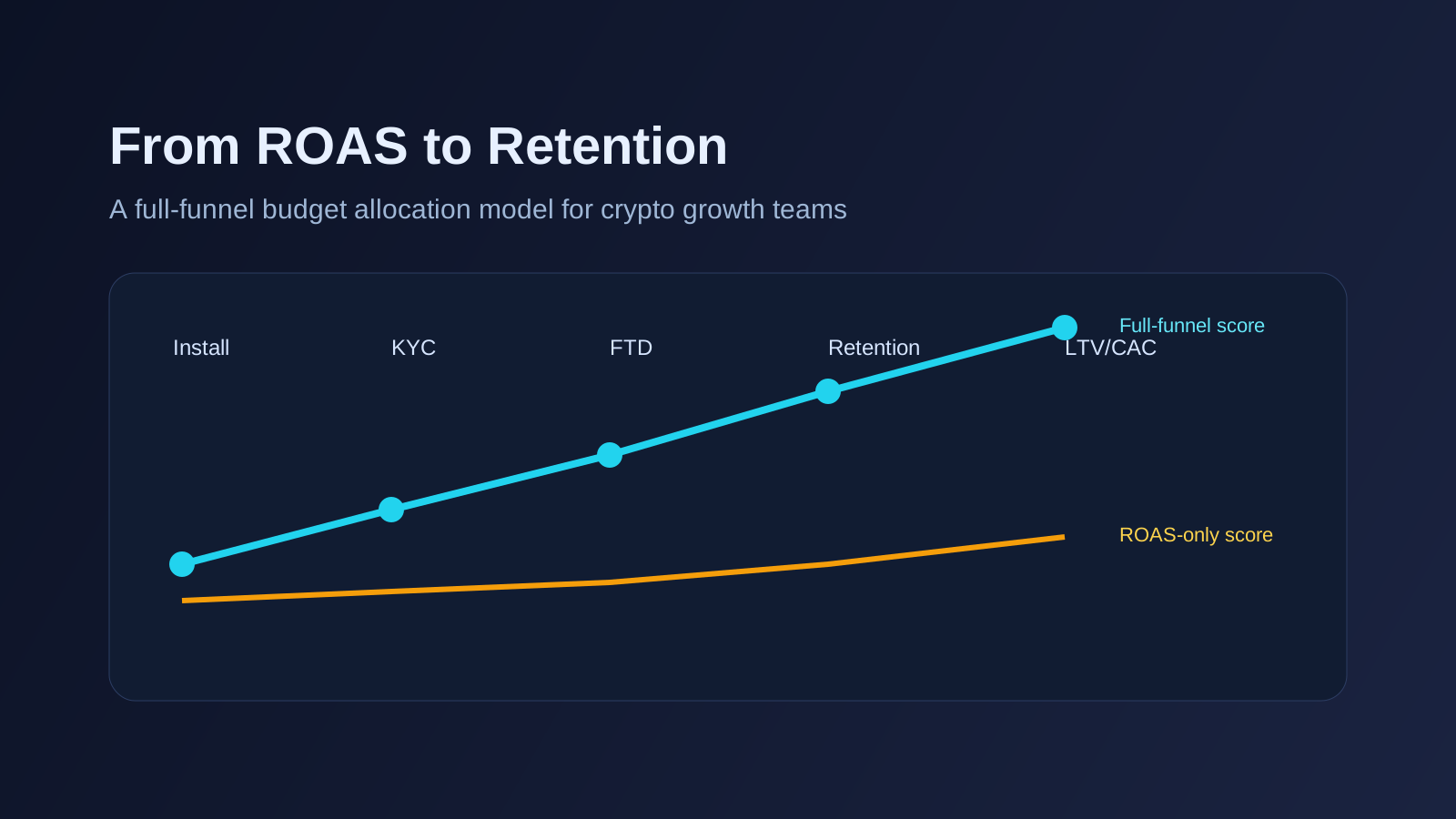
From ROAS to Retention: The Complete Crypto Growth Playbook for Full-Funnel Budget Allocation
A framework for crypto growth teams to allocate budget using full-funnel economics across ROAS, KYC, FTD, and retention.
Get Your Free Crypto Funnel Audit
Upload your CSV and instantly see where users drop off from install to first deposit — free.
From ROAS to Retention: The Complete Crypto Growth Playbook for Full-Funnel Budget Allocation
Crypto marketing teams are under constant pressure to show fast returns. The result is predictable: channels get judged by short-term ROAS snapshots, spend shifts aggressively, and teams celebrate temporary wins while long-term cohort quality quietly declines.
The fix is not “ignore ROAS.” The fix is to place ROAS inside a full-funnel allocation model that includes conversion quality, deposit behavior, and retention economics.
This guide shows how to move from short-term ROAS thinking to a durable revenue system built around the full crypto funnel.
The Problem with ROAS-Only Decision Making
ROAS is useful, but incomplete. It can mislead when:
Attribution windows are too short.
Revenue recognition timing is uneven.
Channels drive different user quality profiles.
Retention curves vary significantly by source.
Two channels can show similar day-7 ROAS but radically different day-30 value because one channel attracts users with stronger activation and repeat deposit behavior.
When teams optimize only for near-term ROAS, they often overfund low-quality traffic that “looks good early” and underfund high-intent cohorts that monetize more steadily.
The Full-Funnel Lens You Need
A resilient crypto growth model tracks three layers together:
Acquisition efficiency: CPI, CPA, cost per KYC approved.
Monetization conversion: FTD rate, average first deposit, FTT.
Cohort durability: D7/D30 retention, repeat deposit behavior, LTV realization.
Budget allocation decisions should only be made when these three layers are visible in the same view.
Core Funnel Stages for Allocation Logic
Use a shared stage model:
Install
Registration
KYC Started
KYC Approved
FTD
FTT
Retained Active User (D7 / D30)
If your budget framework skips any of these, you can’t reliably separate channel volume from channel quality.
The Allocation Objective: Maximize Long-Term Contribution Margin
Your true objective is not highest CTR, lowest CPI, or highest short-term ROAS. It is maximum contribution margin from cohorts over a defined payback window.
Contribution perspective per channel/campaign:
Revenue from cohort over window.
Minus variable acquisition cost.
Minus incentive and payment costs.
Minus risk-adjusted losses.
This gives a more accurate scaling signal than ad-platform ROAS alone.
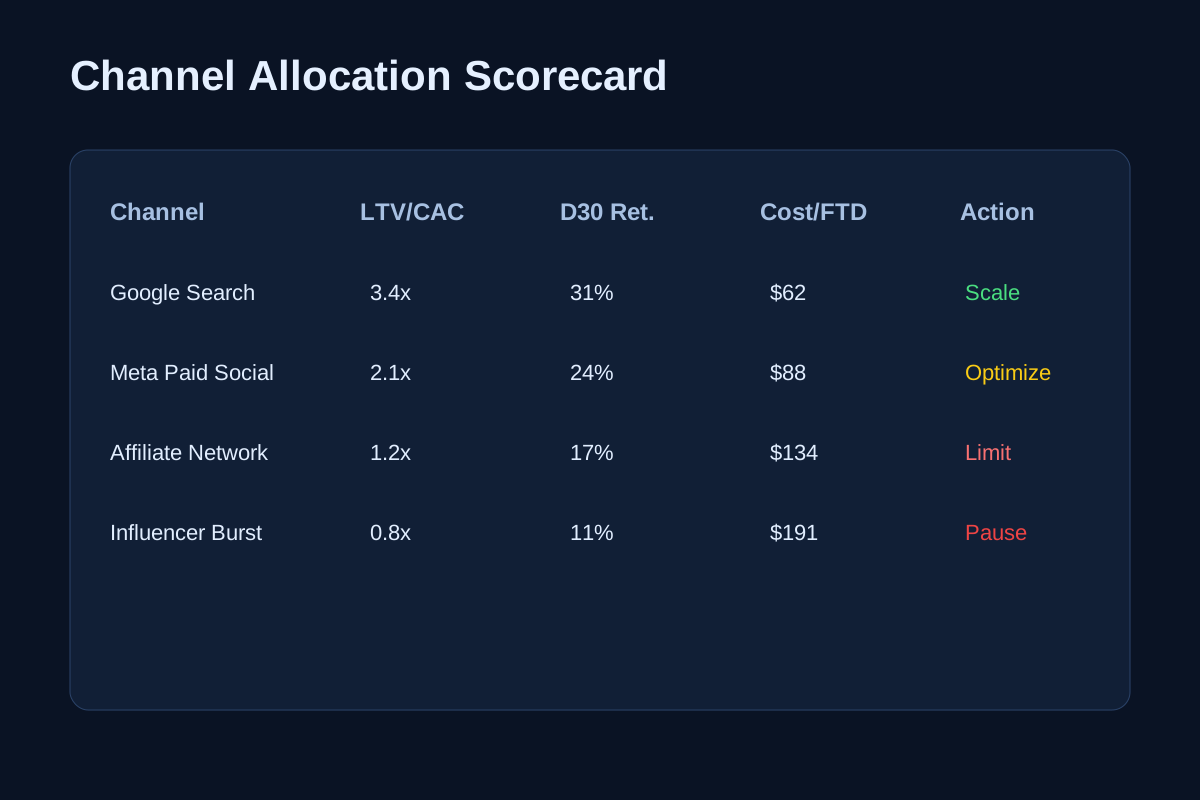
Build a Practical Channel Scorecard
For each channel, track:
Spend
Installs
Registrations
KYC approvals
FTD count
Avg first deposit
D7 and D30 retention
Estimated LTV (30/60/90 day)
Cost per KYC approved
Cost per FTD
Payback period
Then assign channel state:
Scale
Hold and optimize
Limit
Pause
Use clear thresholds to remove emotional budget moves.
Why Crypto Funnel Analyzer Matters Here
You can’t make these decisions with fragmented dashboards. Crypto Funnel Analyzer helps unify the exact data needed for full-funnel allocation:
Funnel stage conversion tracking.
Channel and country breakdowns.
Unit economics (CPI, ROAS, LTV estimates).
Alerting for KYC/FTD/CPI anomalies.
Cohort behavior visibility through retained stages.
It turns paid decisions into measurable, repeatable operations.
The 10-Step Budget Allocation Framework
Step 1: Freeze a clean measurement window
Pick a consistent decision window, e.g., last 30 days for action and last 90 days for context. Do not compare mixed windows.
Step 2: Normalize attribution assumptions
Ensure attribution logic is consistent across channels before comparing outcomes. Misaligned windows will distort budget decisions.
Step 3: Calculate stage-level economics
For each channel:
Cost per registration.
Cost per KYC approved.
Cost per FTD.
Revenue per approved user.
This reveals where spend is leaking before monetization.
Step 4: Add retention weighting
Channels with stronger D30 retention deserve higher strategic weight, even if short-term ROAS is equal.
Step 5: Segment by country and platform
Channel performance is rarely uniform across geos/devices. Allocate at segment level where possible.
Step 6: Rank by risk-adjusted upside
Prioritize channels with:
Positive unit economics.
Stable conversion quality.
Reliable operational scalability.
Step 7: Define allocation guardrails
Example guardrails:
No channel can grow >25% WoW without maintained KYC and FTD quality.
Any segment with cost per FTD above threshold moves to “optimize” state.
Any severe quality alert triggers temporary spend cap.
Step 8: Move budget in controlled increments
Avoid massive overnight reallocations. Use gradual shifts and measure response to avoid feedback shocks.
Step 9: Pair budget shifts with product fixes
Scaling low-quality traffic rarely works. Product and growth teams must jointly remove conversion friction first.
Step 10: Review weekly, rebalance monthly
Weekly operational tuning plus monthly strategic reallocation gives speed without chaos.
A Working Allocation Model (Simple and Effective)
Create a weighted score by channel/country cohort:
Allocation Score =
(FTD Rate x 0.20)
+ (KYC Approval Rate x 0.15)
+ (D30 Retention x 0.20)
+ (LTV/CAC Ratio x 0.30)
+ (ROAS x 0.10)
- (Volatility Penalty x 0.05)
Normalize all components to comparable ranges.
Interpretation:
Highest scores receive growth budget.
Medium scores receive optimization budget.
Low scores receive maintenance or pause.
This avoids overfitting to a single metric.
Channel Archetypes and How to Allocate
Archetype A: High-volume, weak quality
Signal:
Strong installs.
Weak KYC or FTD.
Action:
Reduce scale incrementally.
Tighten targeting/creative intent.
Reassess after quality recovery.
Archetype B: Moderate volume, strong durability
Signal:
Average short-term ROAS.
Strong D30 retention and repeat deposits.
Action:
Increase budget with controlled ramp.
Protect this channel from short-term bias.
Archetype C: Low volume, high upside niche
Signal:
Strong unit economics but limited scale today.
Action:
Allocate test budget to unlock scale constraints.
Invest in new creatives and audience expansion.
Archetype D: Volatile performance
Signal:
Unstable week-over-week outcomes.
Action:
Keep budget conservative.
Demand stability before scaling.
Country-Level Allocation Strategy
Country effects can outperform channel-level effects. A “good channel” globally may be poor in specific markets.
Country playbook:
Break scorecards by geo.
Identify top ROI geos with strong KYC and FTD performance.
Isolate geos with approval or payment friction.
Localize creatives, KYC guidance, and payment onboarding.
Spend should follow geo-level economics, not global averages.
Retention as an Allocation Multiplier
A channel that delivers users who retain and deposit repeatedly deserves premium valuation.
Use retention multipliers:
D7 retention baseline = 1.0x.
D30 above benchmark = 1.2x to 1.4x allocation weight.
D30 below benchmark = 0.7x to 0.9x weight.
This keeps budget focused on durable revenue, not temporary spikes.
Handling Volatility in Crypto Market Cycles
Crypto markets are cyclical. Conversion behavior shifts with sentiment, asset volatility, and news cycles. Build resilient allocation logic:
Maintain scenario bands (bull, neutral, risk-off).
Use rolling averages plus anomaly detection.
Avoid chasing single-day signal shifts.
Stress-test channel economics under lower conversion assumptions.
This prevents overreaction during market turbulence.
Creative Strategy and Funnel Quality
Creative choices strongly influence funnel quality. Overpromising ads can inflate installs while damaging KYC and FTD conversion.
Creative principles:
Align expectation with onboarding reality.
Pre-qualify intent with clear value proposition.
Reduce mismatch between ad promise and KYC effort.
Test educational creatives for higher-intent cohorts.
Creative quality is allocation strategy, not just brand strategy.
Integrating Product Roadmap with Budget Decisions
Spend and product are interdependent. If a high-potential segment is blocked by product friction, budget alone cannot solve it.
Joint planning cycle:
Growth identifies high-upside, high-friction segments.
Product prioritizes fixes tied to revenue lift.
Growth scales spend after conversion recovery.
Without this loop, teams oscillate between overspend and underperformance.
Alert-Driven Allocation Operations
Set automated alerts so allocation responds to real changes, not intuition.
Suggested alerts:
KYC approval drops below threshold in a high-spend segment.
Cost per FTD increases above guardrail.
CPI spikes with no corresponding FTD lift.
D7 retention drops significantly in scaled channels.
Each alert should map to a predefined action protocol.
A Weekly Allocation Operating Cadence
Run this cadence every week:
Review scorecards by channel and country.
Check alert board and diagnose root causes.
Decide budget shifts (scale/hold/pause).
Assign experiments for weak segments.
Track expected impact and accountability.
This avoids random reallocation and creates organizational memory.
Forecasting Impact Before Moving Budget
Before changing spend, run a simple scenario model:
Inputs:
Current spend by channel.
Expected conversion chain (KYC, FTD, retention).
Expected LTV per cohort.
Output:
Expected incremental FTD.
Expected incremental retained users.
Expected payback timeline.
Move budget only when expected impact is clear enough to justify execution risk.
Practical Example: Reallocating 20% of Spend
Assume monthly spend is $500,000.
Current split:
Channel A: 40%
Channel B: 30%
Channel C: 20%
Channel D: 10%
Scorecard shows Channel B has strongest D30 and LTV/CAC despite moderate day-7 ROAS. Channel A has strong volume but weak post-KYC conversion.
Action:
Shift 10% from A to B.
Shift 5% from A to C (high-upside niche).
Keep 5% as experiment reserve.
If B and C maintain quality after 2-3 weeks, continue gradual reallocation. If not, revert by predefined thresholds.
Common Allocation Mistakes in Crypto Growth Teams
Mistake 1: Overweighting top-of-funnel volume
Volume without monetization quality increases future CAC pressure.
Mistake 2: Ignoring segment heterogeneity
Global averages hide the best and worst opportunities.
Mistake 3: Treating ROAS as fixed truth
ROAS is model-dependent and window-dependent. It must be contextualized.
Mistake 4: Reallocating too aggressively
Fast, large shifts can destabilize learning and inflate volatility.
Mistake 5: No reserve for experiments
Without exploration budget, allocation gets stuck in local maxima.
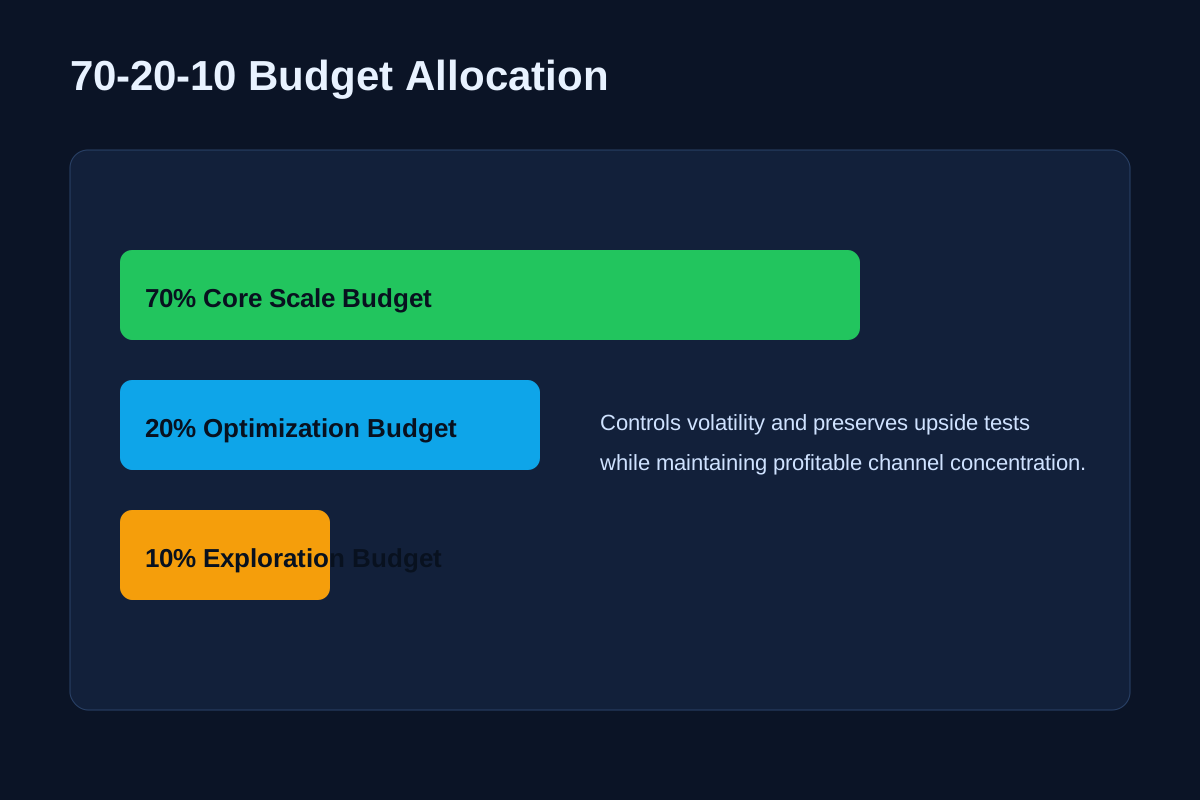
The 70-20-10 Budget Structure
A practical allocation split:
70% Core scale budget: proven channels/segments.
20% Optimization budget: improve medium-performance segments.
10% Exploration budget: new channels, geos, creative angles.
This balances performance reliability with growth discovery.
Designing Better Channel Experiments
Every allocation test should define:
Hypothesis.
Target segment.
Spend range.
Success criteria.
Stop-loss criteria.
Observation window.
Avoid broad “test more creatives” directives. Experiments need strict definitions.
Executive Reporting: What Leadership Should See
Leadership dashboard should include:
Spend by channel state (scale/optimize/pause).
Cost per FTD trend.
LTV/CAC trend by top channels.
Retention quality movement.
Forecasted payback shifts from recent reallocations.
This keeps strategic decisions anchored to durable outcomes.
Building a Full-Funnel Growth Culture
The strongest teams align incentives across functions:
Growth teams rewarded for quality-adjusted acquisition.
Product teams rewarded for funnel throughput.
Analytics teams rewarded for decision speed and clarity.
Leadership rewarded for sustainable payback, not vanity spikes.
Culture determines whether your allocation framework survives pressure.
Long-Term Advantage: Better Decisions Under Uncertainty
Crypto markets evolve quickly. Channels saturate, regulations shift, and user behavior changes with market conditions. Teams that win are not those with one best channel. They are teams with better allocation systems.
A robust full-funnel framework helps you:
Reallocate faster with less risk.
Detect quality drift earlier.
Preserve margin during volatility.
Scale durable cohorts with confidence.
Final Takeaway
ROAS is a valuable signal, but it is only one signal.
For crypto businesses, budget allocation must connect acquisition cost, compliance conversion, first deposit behavior, and retention durability in one operating model.
When you combine stage-level conversion metrics, cohort economics, and disciplined allocation governance, you stop chasing short-term spikes and start building a growth engine that compounds.
That is the difference between spending efficiently this month and scaling profitably for the next twelve months.
Advanced Cohort Economics: Beyond First Deposit
First deposit is essential, but not sufficient for allocation quality. Channels that generate larger first deposits are not always channels that produce stronger lifetime behavior.
Track post-FTD behavior by cohort:
Repeat deposit rate by D7 and D30.
Average cumulative deposit by D30.
First trade completion rate.
Active trading days per user.
Net revenue per active depositor.
These metrics help identify channels that attract users with genuine product-market fit versus users who convert once and disappear.
Payback Period as a Board-Level Metric
When budgets grow, leadership should monitor payback periods with stage-level diagnostics.
Recommended view by channel:
Spend date.
Cohort revenue accumulation curve.
Date when cumulative gross profit covers acquisition cost.
Then annotate with funnel realities:
Did payback improve due to better KYC conversion?
Due to higher FTD value?
Due to stronger retention?
This ensures budget discussions are anchored in economic mechanics, not marketing narratives.
Building Tiered Budget Rules
Not every channel should be managed with identical thresholds. Build tiered policy rules:
Tier 1 (Mature channels):
Tight efficiency guardrails.
Predictable weekly scaling caps.
Strict stop-loss triggers.
Tier 2 (Growth channels):
Moderate guardrails.
Experiment-driven scaling.
Longer observation windows.
Tier 3 (Exploration channels):
Small budgets.
Hypothesis-first testing.
Rapid kill criteria.
Tiered rules reduce organizational confusion and improve decision speed.
Managing Creative Fatigue with Funnel Signals
Creative fatigue is often detected too late when CPC rises sharply. In crypto growth, you should detect fatigue through funnel quality movement too.
Signals of fatigue:
Install volume stable but registration intent weakens.
KYC start rate declines for previously strong audiences.
FTD rate drops despite similar CPI.
Action plan:
Rotate creative themes by audience maturity.
Refresh intent framing, not just visual design.
Validate new hooks with quality metrics, not click rate alone.
Multi-Touch Reality in Crypto Journeys
Many users do not convert after one touchpoint. They may:
Discover via social.
Return via search.
Convert after direct visit.
If attribution is last-click only, you may underinvest in channels that influence early intent. Build a practical blended model:
Keep platform attribution for tactical optimization.
Maintain internal blended attribution for strategic allocation.
Reconcile differences monthly.
Perfect attribution is unrealistic; stable, transparent attribution governance is achievable.
Retention Curve Diagnostics
Look beyond single D30 numbers. Plot retention curves by cohort and compare shape:
Steep early drop, then flattening: onboarding quality issue.
Gradual steady decline: weak habit loop or product stickiness.
Strong first week, weak month: monetization mismatch or expectation gap.
Allocation implications:
Onboarding issue: pair spend with product fixes.
Stickiness issue: avoid scaling acquisition until lifecycle interventions improve retention.
Cash-Flow-Aware Allocation
Even profitable channels can create cash stress if payback timing is slow. Build cash-flow-aware budget policy:
Define maximum acceptable payback window by market condition.
Prioritize channels with stronger cash conversion during risk-off periods.
Use slower-payback channels strategically during stable liquidity periods.
This protects operational flexibility.
Whale Contribution and Budget Weighting
In many crypto products, a small segment of users contributes disproportionate revenue. Incorporate whale contribution into allocation logic carefully:
Track whale rate by channel/country.
Track whale retention and risk-adjusted value.
Avoid overfitting to rare spikes.
A channel with occasional whale spikes but unstable median quality should not automatically dominate allocation.
Risk Controls for Rapid Scaling
When a channel enters “scale” state, deploy risk controls:
Frequency caps and audience overlap checks.
Daily anomaly monitoring.
Spend pacing rules by hour/day.
Quality checkpoints every 72 hours.
Scaling without controls can quickly degrade quality and erase gains.
The Experiment Reserve: Your Strategic Optionality
Set aside explicit budget reserve for structured exploration. This is not discretionary leftover spend.
Use reserve for:
New geo entry tests.
New creative positioning.
New channel onboarding.
Funnel flow experiments tied to acquisition source.
Document outcomes rigorously. Over time, this reserve builds an internal playbook that competitors cannot copy quickly.
Operating Model: Who Owns What
Clear ownership accelerates allocation decisions:
Growth lead: budget changes and channel state decisions.
Product lead: funnel friction fixes and activation improvements.
Analytics lead: scorecard integrity and impact measurement.
Ops/compliance lead: KYC and risk policy constraints.
Run one shared decision forum instead of fragmented team meetings.
Monthly Strategy Review Template
Use this structure monthly:
Which channels created the most retained value?
Which channels consumed spend without durable value?
Which countries improved or degraded significantly?
Which experiments graduated to scale policy?
Which assumptions failed and need model updates?
What is next month’s reallocation map?
Consistency in review structure matters more than complexity.
Building Confidence Intervals Into Decisions
Do not treat every point estimate as truth. For newer or lower-volume channels, uncertainty can be high.
Use simple confidence-aware policy:
High confidence + strong economics: scale.
High confidence + weak economics: limit/pause.
Low confidence + mixed economics: maintain test budget until clearer signal.
This prevents overreaction to noisy data.
Incentive Design to Reinforce Full-Funnel Thinking
If teams are rewarded only on top-of-funnel numbers, allocation discipline breaks. Align incentives to full-funnel outcomes:
Growth KPIs: cost per FTD, quality-adjusted LTV/CAC.
Product KPIs: stage throughput and activation latency.
Shared KPI: retained revenue per acquisition dollar.
What you incentivize is what gets optimized.
Scaling Playbook for a Winning Segment
When a segment proves strong, scale with controlled sequence:
Validate data stability across 2-3 consecutive weeks.
Increase budget in planned increments.
Monitor stage conversion quality daily.
Expand adjacent audiences/keywords gradually.
Refresh creatives before fatigue harms quality.
Lock a fallback budget if signal weakens.
Structured scaling protects gains.
De-Scaling Playbook for a Declining Segment
When a segment declines:
Confirm decline is real (not data anomaly).
Identify failing stage (KYC, FTD, retention).
Reduce spend in phases.
Launch targeted remediation experiments.
Re-enter scale only after recovery criteria are met.
This avoids panic and preserves optionality.
What Great Looks Like After 90 Days
After 90 days of disciplined full-funnel allocation, teams typically see:
Lower cost per FTD.
More stable ROAS over time.
Improved retention-adjusted revenue.
Faster decision cycles.
Fewer budget whiplash events.
The biggest gain is decision quality under pressure.
Closing Operating Principles
Use these principles as your durable framework:
Measure the full conversion chain, not isolated steps.
Prioritize quality-adjusted economics over vanity scale.
Reallocate gradually, not reactively.
Preserve exploration budget at all times.
Integrate growth and product roadmaps.
Build governance rhythms that survive volatility.
When your team adopts these principles, allocation becomes a compounding capability. Competitors can copy channels and creatives. They cannot easily copy a high-discipline growth operating system.
And in crypto markets, operating system quality is often the difference between temporary spikes and sustained profitability.
CryptoFunnel Team
Crypto Analytics Experts
We help crypto and Web3 companies optimize their user acquisition funnels — from install to first deposit. Our analytics platform is trusted by 500+ teams worldwide.
Verified Data
Real campaign metrics
500+ Teams
Trust our platform
Always Current
Regularly updated