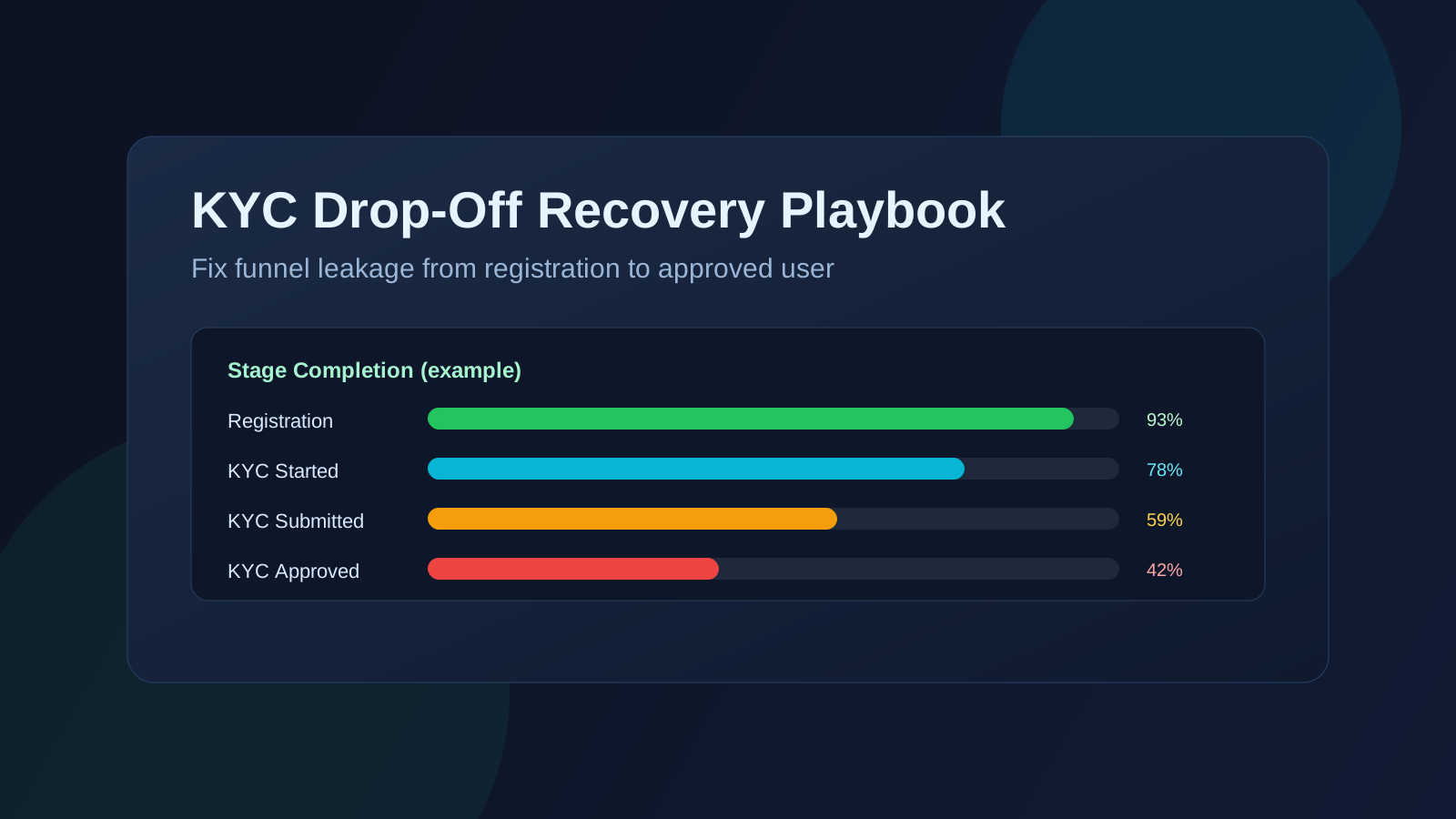
KYC Drop-Off in Crypto Funnels: The Complete Playbook to Recover Conversion and Revenue
A practical playbook for crypto teams to diagnose, fix, and scale KYC performance from registration to FTD and retention.
Get Your Free Crypto Funnel Audit
Upload your CSV and instantly see where users drop off from install to first deposit — free.
KYC Drop-Off in Crypto Funnels: The Complete Playbook to Recover Conversion and Revenue
Crypto growth teams usually notice the same painful pattern after scaling installs: top-of-funnel looks healthy, registration looks acceptable, and then KYC completion collapses. Campaign dashboards still report “good traffic,” but revenue lags, sales teams get fewer qualified accounts, and paid CAC quietly drifts up.
This is not just an onboarding UX issue. In crypto, KYC is a commercial conversion stage. If KYC performance drops, your paid engine loses compounding efficiency at every downstream stage: first-time deposit (FTD), first trade/transaction (FTT), and retention.
This guide is a practical, operator-first playbook to fix KYC drop-off using funnel analytics, segmentation, and disciplined experimentation.
Why KYC Is the Economic Center of the Crypto Funnel
A common mistake is treating KYC as “compliance overhead.” In practice, KYC is the stage where low-intent traffic gets filtered and high-intent users either convert or abandon. That means KYC completion rate has direct influence on:
Effective cost per activated user.
Cost per FTD.
Paid channel quality scores.
LTV payback windows.
Revenue forecast reliability.
If your installs are increasing while KYC completion is flat or declining, your actual growth quality is weakening. That can remain hidden for weeks unless you track funnel stages together.
The Baseline Funnel Model You Need
Before you optimize, you need clear stage definitions that your whole team shares:
Install: user installs app/web product.
Registration: user creates account.
KYC Started: user enters identity flow.
KYC Submitted: user uploads required data/docs.
KYC Approved: verification passes.
FTD: first successful deposit.
FTT: first trade or transaction.
Retention milestone: active at day 7/30.
Most teams only track “registration to approved KYC.” That hides where users actually fail. You should split KYC into at least three states: started, submitted, approved.
Symptoms of a KYC Problem (and What They Usually Mean)
Symptom 1: Registration grows, KYC approvals stay flat
Typical causes:
Broader, lower-intent traffic mix.
New geos with stricter document mismatch rates.
UX friction in “start KYC” CTA.
Symptom 2: KYC started is high, KYC submitted is low
Typical causes:
Form fatigue.
Poor field validation and unclear errors.
Low trust at document upload step.
Symptom 3: KYC submitted is high, approvals drop
Typical causes:
ID quality issues (blurry photos, unsupported docs).
Third-party vendor false negatives.
Country-specific document acceptance gaps.
Symptom 4: KYC stable, FTD declines
Typical causes:
Deposit UX friction.
Payment rails mismatch by country.
Wrong channel mix (users pass KYC but low monetization intent).
The key is stage isolation. Without that, teams overreact to the wrong layer.
A 7-Step KYC Recovery Framework
Step 1: Build a clean diagnostic slice
Run a 14- or 30-day analysis with the same date logic for every stage. Segment by:
Channel.
Country.
Platform (iOS, Android, web).
Campaign cohort/week.
Then calculate:
Reg rate = registrations / installs.
KYC start rate = KYC started / registrations.
KYC submit rate = KYC submitted / KYC started.
KYC approval rate = KYC approved / KYC submitted.
FTD post-KYC = FTD / KYC approved.
This breaks a vague “KYC problem” into observable failure points.
Step 2: Identify where loss compounds most
Not every drop-off deserves equal priority. Focus on the point where:
Absolute volume loss is highest.
Downstream revenue sensitivity is highest.
Fix effort is realistic in 1-2 sprints.
Example:
If KYC submit rate falls from 68% to 52%, you might lose more revenue than a 3-point change in approval quality. Fix where recovery volume is largest first.
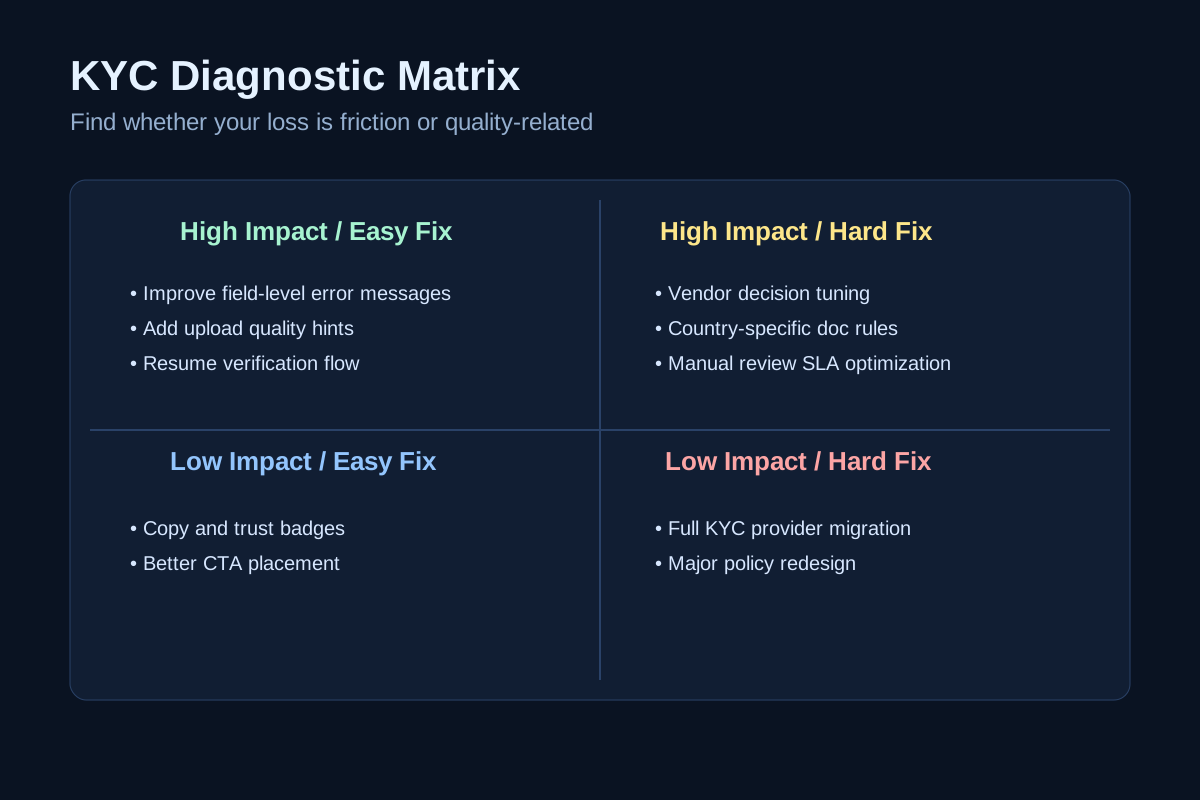
Step 3: Separate quality problems from friction problems
KYC loss has two broad classes:
Friction loss: users abandon because flow is slow/confusing.
Quality loss: users complete flow but fail verification.
Use this simple decision logic:
Large drop between started and submitted: mostly friction.
Large drop between submitted and approved: mostly quality/vendor/rule logic.
Mixing these leads to wasted effort.
Step 4: Prioritize by segment economics
Do not optimize global averages only. Rank segments by commercial impact:
High spend + high drop-off + high LTV potential.
High spend + high drop-off + low LTV potential.
Low spend segments.
A 5-point fix in a high-volume, high-LTV channel can outperform a 15-point fix in low-value traffic.
Step 5: Launch controlled KYC experiments
Run scoped tests with clear success criteria.
Good experiments:
Progressive disclosure in KYC forms.
Better field-level guidance and examples.
Trust copy around data handling and security.
Document capture improvements (lighting hints, auto-crop, retry UX).
Country-specific ID instructions.
Alternative verification path for known failure patterns.
Bad experiments:
Multiple major changes at once.
Launching without baseline segment metrics.
Declaring success on click-through, not approval or FTD lift.
Step 6: Connect KYC performance to paid budget
Your media team needs KYC-aware optimization, not install-only bidding logic.
Per channel/campaign, track:
Cost per registration.
Cost per KYC approved.
Cost per FTD.
30-day LTV/CAC ratio.
Then use simple rules:
Scale channels with strong KYC-to-FTD efficiency.
Cap or pause channels with persistent KYC leakage.
Re-test creatives in segments with good intent but poor KYC UX.
Step 7: Set alerting and governance
Optimization breaks without operational rhythm. Define alerts such as:
KYC submit rate drops > X% week-over-week.
KYC approval rate below threshold.
Country-level approval anomalies.
Sudden channel-level CPI spike with KYC decline.
Assign owners by function:
Growth: channel and campaign quality.
Product: flow friction and UX.
Ops/Compliance: approval rules and vendor quality.
How Crypto Funnel Analyzer Helps You Execute This
Crypto Funnel Analyzer is useful here because it tracks the full sequence from acquisition to monetization in one environment. Instead of stitching spreadsheets from ad platforms and KYC provider exports, you can read funnel health through one lens:
Stage conversion view from Install to Retention.
Channel comparison tied to FTD and LTV outcomes.
Country-level red flags.
Whale and high-value cohort behavior.
Alerts on KYC, FTD, and CPI risk movements.
KYC Metrics That Actually Matter
Many dashboards over-index on vanity or partial metrics. Focus on these:
1) KYC Start Rate
Signals onboarding intent. If low, fix transition from registration to verification start.
2) KYC Submit Rate
Signals flow usability. If low, inspect form design, instructions, and upload friction.
3) KYC Approval Rate
Signals document quality, policy fit, and vendor decision reliability.
4) Approval Time to Decision
If approval time is long, user trust and momentum decay before deposit.
5) FTD Conversion After KYC Approval
This is the commercial quality checkpoint. Good KYC completion with weak FTD indicates monetization friction, not KYC success.
6) Cost per KYC Approved
The strongest bridge metric between media spend and compliance conversion quality.
Segment-by-Segment Optimization Tactics
Channel Tactics
For paid social channels: tighten creative promise to reduce low-intent registrations.
For search: align keyword intent with KYC readiness messaging.
For affiliates: enforce quality thresholds on post-registration behavior.
Country Tactics
Localized examples for accepted IDs.
Country-specific error copy.
Fallback KYC journey for common regional doc types.
Time-zone aligned support windows for verification issues.
Platform Tactics
Mobile camera quality helper states.
Device permission prompts with clear rationale.
Shorter step clusters on small screens.
Save-progress and resume for long forms.
Cohort Tactics
Compare cohorts by acquisition week to isolate regressions.
Separate “new market launch” effects from product changes.
Track experiment cohorts distinctly to avoid contaminated conclusions.
KYC Experiment Backlog You Can Run Next Sprint
Registration success screen with explicit KYC value proposition.
Two-step KYC intro (why + how long + security assurance).
Real-time input validation with plain-language corrections.
Camera upload quality checks before submission.
Country-aware document recommendations.
Post-failure recovery flow with exact fix guidance.
Auto-reminder sequence for partially completed KYC.
Live support trigger on repeated field failures.
Trusted badges/security messaging near upload CTA.
“What happens next” timeline after submission.
Each experiment should map to one KPI and one owner.
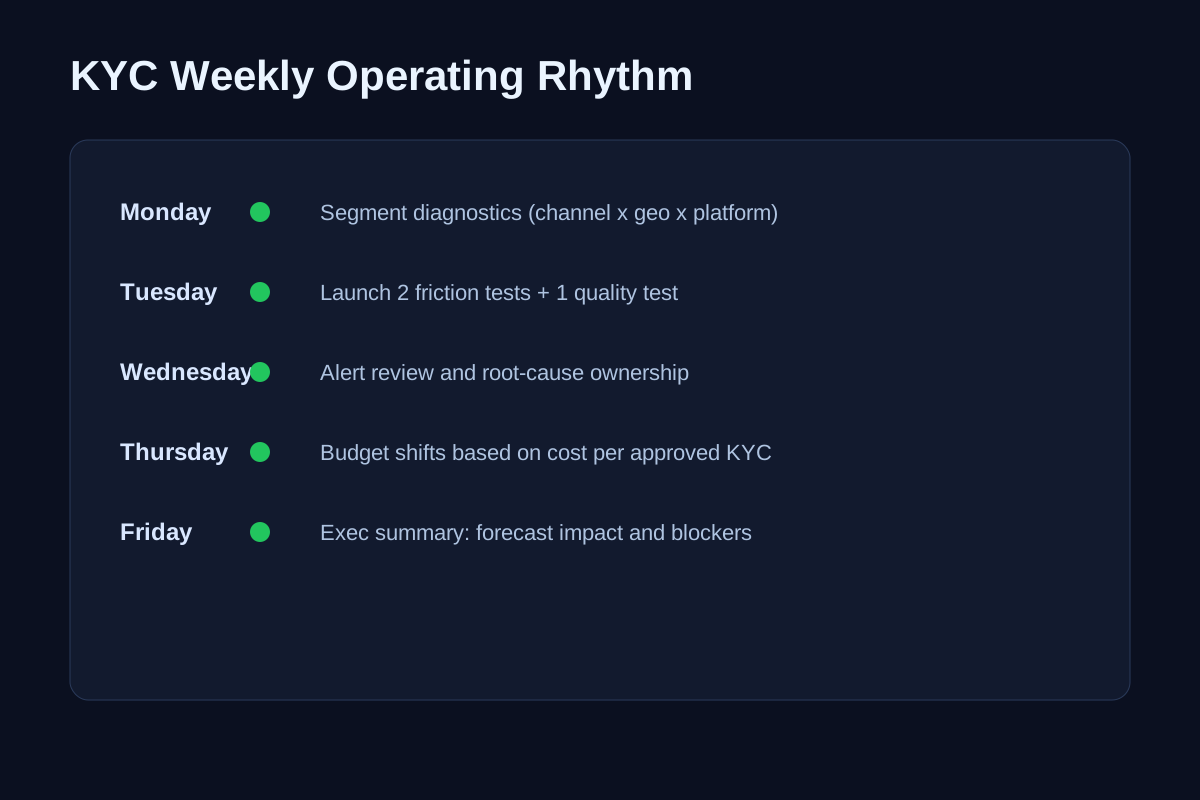
Governance: The Weekly KYC Performance Review
Run a 30-minute KYC operating review every week with this agenda:
Funnel movement by stage (WoW).
Segment leaderboard: best and worst channels/countries.
Experiment readout: wins, losses, next action.
Alerts review and root-cause notes.
Budget and roadmap changes for next week.
Keep this meeting operational, not narrative. Every data point should connect to a decision.
Common Mistakes That Destroy KYC Performance
Mistake 1: Buying cheaper traffic to “fix CAC”
Cheaper installs often worsen KYC quality and increase cost per depositor.
Mistake 2: Overfocusing on global averages
Local anomalies get hidden until they become expensive.
Mistake 3: Treating compliance and growth as separate systems
In crypto funnels, they are one system. Misalignment creates conversion leaks.
Mistake 4: Measuring only same-day results
Some KYC flows resolve later. Track lag curves and cohort maturation windows.
Mistake 5: Shipping redesigns without stage-level instrumentation
No instrumentation means no learning, even when conversion changes.
Forecasting the Value of KYC Recovery
A simple impact model helps justify priorities.
Assume monthly:
100,000 installs.
45% registration rate = 45,000 registrations.
55% KYC start = 24,750 starts.
60% submit = 14,850 submissions.
70% approval = 10,395 approved.
30% FTD post-KYC = 3,118 FTDs.
If you improve submit rate from 60% to 66%:
Submissions increase to 16,335.
Approved increase to 11,434.
FTD increases to 3,430.
That is +312 FTDs/month before any media spend increase.
This is why KYC optimization often beats pure top-funnel scaling.
Implementation Checklist
Use this checklist to operationalize quickly:
Define KYC stage schema (start, submit, approve).
Confirm event tracking parity on web + mobile.
Build 30-day segmented baseline.
Set alert thresholds for KYC and downstream FTD.
Rank top 5 loss segments by revenue impact.
Launch 2 friction tests + 1 quality test.
Measure with cohort windows, not vanity CTR.
Review weekly and tie outcomes to budget decisions.
Internal Reporting Template (Copy/Paste)
Time window: Last 30 days.
Total installs, registrations, KYC starts/submits/approvals.
Stage conversion rates and WoW change.
Top 3 improving and top 3 declining segments.
Cost per KYC approved by channel.
FTD post-KYC by channel/country.
Active experiments and expected impact.
Next-week actions with owners.
Use the same template each week to create institutional learning.
Final Takeaway
KYC is not a compliance checkpoint bolted onto growth. It is the conversion bridge between paid acquisition and revenue realization in crypto.
When KYC drop-off increases, everything downstream gets more expensive. When KYC performance improves, every dollar of media spend works harder.
The winning teams treat KYC like any high-value funnel stage: instrumented, segmented, tested, and governed with consistent operating cadence.
If you apply the framework in this guide, you will not just improve KYC completion. You will improve cost efficiency, FTD volume, and revenue quality across your entire funnel.
Advanced Diagnostic Layer: Time-to-Stage and Lag Curves
Most teams look at stage percentages but ignore time. In reality, KYC health is also a speed problem. If users need too much time to move from registration to KYC approval, funnel intent decays. Slow conversion behaves like hidden drop-off.
Track these latency metrics:
Registration to KYC start median time.
KYC start to submit median time.
Submit to approval median and p90 time.
Approval to FTD median time.
Why p90 matters: median can look healthy while long-tail users experience serious delays. In crypto markets, long-tail delays often correspond to cross-border docs, weak camera uploads, or manual review bottlenecks.
A practical fix is to set a service-level objective for approval velocity per country tier. Even if total approval rate is stable, reducing latency can lift FTD and first-week retention.
Messaging Strategy Around KYC: Trust and Momentum
Users do not evaluate KYC only as a form. They evaluate risk, legitimacy, and effort at once. That means copy and sequence design materially impact completion.
High-performing KYC messaging patterns:
Explain “why verification is required” in simple language.
Estimate completion time before users begin.
Clarify data security and storage standards.
Set expectations for what unlocks after approval.
Give immediate next-step feedback after each action.
Low-performing patterns:
Generic compliance copy with legal-heavy wording.
Sudden document requests without context.
Vague errors (“invalid input”) without correction hints.
Silent waiting period after submission.
Trust reduces abandonment. Momentum reduces procrastination.
Lifecycle Automations That Recover Abandoned KYC
A large share of KYC abandonment is recoverable if follow-up is fast and contextual. Build lifecycle sequences around abandonment state, not generic reminders.
Recommended recovery flows:
Started but no submission in 30 minutes:
Send quick “resume KYC” reminder with direct deep-link.
Submission failed due to image quality:
Send guidance with examples and one-tap retry path.
Submitted, pending manual review beyond SLA:
Send status transparency update and estimated timeline.
Approved but no deposit within 24 hours:
Trigger first-deposit onboarding message tied to region/payment method.
Avoid spam cadence. Two or three high-context messages outperform daily generic nudges.
KYC Vendor Management: What to Monitor
If you use external verification providers, you need a vendor scorecard that sits beside funnel metrics.
Track per vendor and per country:
Approval rate.
False rejection disputes.
Review latency.
Outage incidents.
Cost per verified user.
When approval rate drops suddenly in multiple geos with unchanged traffic quality, vendor-side model or rule changes are common root causes. Without vendor observability, teams over-blame acquisition.
Fraud vs Conversion: Avoid the False Tradeoff
Teams sometimes assume stronger anti-fraud means lower conversion is unavoidable. That is only partially true. Good systems separate high-risk detection from low-risk user experience.
Approaches that maintain conversion while managing risk:
Progressive risk scoring: apply heavier checks only where needed.
Dynamic friction: low-risk users get faster KYC path.
Post-KYC monitoring: shift some controls after activation.
Behavioral risk signals: combine document checks with activity patterns.
This keeps the onboarding path competitive for legitimate users while preserving controls against abuse.
Mobile-First KYC UX Principles
Crypto onboarding is increasingly mobile-driven. Desktop-oriented KYC flows often fail on smaller screens and low-light environments.
Mobile essentials:
Single-focus screens with one primary action.
Camera instructions before capture, not after failure.
Auto-crop guidance and blur detection.
Resume-anytime state persistence.
Large, clear error messages with correction steps.
Measure iOS vs Android differently. Device camera behavior and permission patterns can create meaningful conversion deltas.
Attribution Reality: KYC-Qualified Acquisition
If your paid team optimizes to installs or registrations only, channel quality drift is inevitable. Move to KYC-qualified acquisition logic.
Use reporting tiers:
Tier 1: install metrics for spend pacing.
Tier 2: registration/KYC metrics for quality control.
Tier 3: FTD/LTV metrics for final allocation.
Decisions should be made at Tier 2 and Tier 3, not Tier 1 alone.
The KYC Quality Score (KQS) Model
Create a simple composite score per channel/country cohort to rank quality:
KQS = (KYC Start Rate x 0.2) + (KYC Submit Rate x 0.3) + (KYC Approval Rate x 0.3) + (FTD Post-KYC x 0.2)
Normalize each component to 0-100 scale. Then classify:
80-100: scale candidates.
60-79: hold and optimize.
<60: reduce spend or redesign flow for that segment.
KQS gives media and product teams a common language for prioritization.
Post-KYC Monetization Bridge
Many teams “celebrate approval” and stop. That leaves value on the table. Approved users still need a short, confident path to first deposit and first transaction.
Immediate post-KYC playbook:
Show clear “account verified” confirmation state.
Prompt first funding action with local payment context.
Provide onboarding tips for safe first trade.
Offer lightweight in-app guidance for next 24 hours.
Measure approval-to-FTD time as a first-class KPI.
Country Launch Checklist to Protect KYC Performance
When entering new markets, teams often spend before KYC flow localization is ready. Use this pre-launch checklist:
Document type coverage validated.
Local language support for errors and guidance.
Country-specific compliance copy reviewed.
Support macros prepared for likely failure reasons.
Payment methods aligned with verified-user expectations.
This avoids expensive “learn by attrition” cycles.
Quarterly KYC Audit Framework
Run a structured audit every quarter:
Stage conversion trend over last 90 days.
Latency trend and SLA compliance.
Vendor performance drift analysis.
Segment economics (cost per approved + cost per FTD).
Experiment archive: wins, losses, reusable patterns.
Compliance or policy change impact review.
Archive findings and convert into a 90-day roadmap.
Executive Dashboard View (What Leadership Should See)
Executives do not need raw detail. They need risk and direction:
Cost per KYC approved trend.
KYC approval volume vs media spend trend.
Top 3 growth blockers and owners.
Forecast impact of current optimization roadmap.
This keeps leadership aligned with operational reality.
Case Pattern: What a Successful Recovery Looks Like
A typical recovery pattern over 6-8 weeks:
Week 1-2: instrument stage split (start/submit/approve), identify major loss node.
Week 3-4: ship friction fixes, improve submit rate.
Week 5-6: tune vendor/rule handling, recover approval quality.
Week 7-8: align budget to improved segments, increase FTD with stable CAC.
The biggest gains usually come from consistency, not one “magic” redesign.
Closing Framework
If you want KYC to become a growth advantage rather than a bottleneck, operate with this sequence:
Measure every stage and latency clearly.
Segment by channel, country, and platform.
Prioritize fixes by revenue-weighted impact.
Run focused experiments with ownership.
Align paid budget to KYC-qualified outcomes.
Govern weekly, audit quarterly.
Teams that do this outperform competitors who only scale top-of-funnel. In crypto markets where acquisition costs swing quickly, KYC efficiency becomes one of the most defensible levers in the entire growth system.
CryptoFunnel Team
Crypto Analytics Experts
We help crypto and Web3 companies optimize their user acquisition funnels — from install to first deposit. Our analytics platform is trusted by 500+ teams worldwide.
Verified Data
Real campaign metrics
500+ Teams
Trust our platform
Always Current
Regularly updated